by Sherri Eisenberg S
AOL Travel online
May 25th 2010
Most people would kill for Samantha Brown's job. The Travel Channel host spends 230 days a year covering about 100,000 miles for shows like "Samantha Brown's Great Weekends", now in it's second season. She is also wrapping up "Samantha Brown's Destinations" and "Samantha Brown's Asia". Her last trip? To Indonesia. It took her 36 hours to get home. "The trip began on a horse and cart, then a boat, a car, and 4 plane rides later I was home," she says.
Like any seasoned traveler, Brown has learned a thing or two about cultural differences over the years, especially about what to pack to blend in with the locals. "I know that what works for job interviews also works in travel," says Brown. "First impressions mean a lot and looking good has a lot to do with that." Taking cues from the local style does more than make you more comfortable, she says, it also protects you. "You want to dress as close to as the locals do if only as to not be targeted as a tourist with a nice camera and wallet full of money and credit cards, even if you have neither," says Brown. But what works on one continent doesn't necessarily work on another. Here Brown shares with us her best advice on how to dress for the destination, culled from a decade on the road.
To read the rest of the article... click here.
Showing posts with label travel. Show all posts
Showing posts with label travel. Show all posts
Friday, June 11, 2010

Friday, May 14, 2010

Tuesday, April 6, 2010
The 7 Most Surprising Wine Regions
From China to Croatia and Beyond
By: Carly Wray, Snooth.com
Business sherpa says... "Some real surprises here."
You know that Croatia has a heartbreakingly gorgeous coastline, and that Idaho has famous potatoes -- but did you know that they both produce notable wine? It's not just novelty: More and more regions around the world are beginning to create legitimately intriguing, attention-worthy wines.
Some are just now climbing out of the jug wine ghetto, while others have been steadily building a tradition of fine winemaking for centuries. From Macedonia to the frozen vineyards of Ontario, Canada, here are the seven unsung or up-and-coming wine regions to check out next.
1. Croatia
2. Idaho
3. China
4. India
5. Brazil
6. Macedonia
7. Canada
To read more… click here.
By: Carly Wray, Snooth.com
Business sherpa says... "Some real surprises here."
You know that Croatia has a heartbreakingly gorgeous coastline, and that Idaho has famous potatoes -- but did you know that they both produce notable wine? It's not just novelty: More and more regions around the world are beginning to create legitimately intriguing, attention-worthy wines.
Some are just now climbing out of the jug wine ghetto, while others have been steadily building a tradition of fine winemaking for centuries. From Macedonia to the frozen vineyards of Ontario, Canada, here are the seven unsung or up-and-coming wine regions to check out next.
1. Croatia
2. Idaho
3. China
4. India
5. Brazil
6. Macedonia
7. Canada
To read more… click here.
Thursday, September 17, 2009
How to Start an Adventure Travel Company
How to Start an Adventure Travel Company
Check every hotel personally, says Brian Morgan of Adventure Life. Same goes for the zip lines.
By Leigh Buchanan Jul 1, 2009
Company Dashboard: Adventure Life
Founder Brian Morgan, 35
Location Missoula, Montana
2008 Revenue $11 million
Employees 16
Start-up Year 1998
Start-up Costs $3,000 for two brochures and a laptop
Breakeven One year out on sales of $125,000
Biggest Expenses $11,500 on advertising in 1999 and $33,500 in 2000. The biggest bite was print ads in magazines such as Outside and National Geographic Adventure.
Qualifications Fluency in Spanish. Relationships with trusted locals and longtime expats on the ground
Red Tape Regulatory burdens fall on lodges and providers of transportation and other services in countries visited, rather than on the tour operator.
In 1998, Brian Morgan traveled to Ecuador to learn Spanish and because someone he met in college once told him it was beautiful. There he trekked in the shadow of a volcano and rafted through the rain forest to a soundtrack of monkey chatter and birdsong. It would have been easy to put down roots in South America: Morgan envisioned building a life there as a consultant. But heart and home were in his native Montana. So, after some last-hurrah backpacking around Bolivia and Peru, Morgan flew back to Missoula. He hoped to land a job that would support regular visits south of the equator.
Then Morgan had an idea. "I thought I could put a group of people together a few times a year and take them to Ecuador -- show them the things that I found most spectacular," he says. His nascent business, Adventure Life, would lead travelers off the beaten path toward encounters with the land and culture. On some nights, clients would luxuriate in hot baths at a charming hotel. On others, they would rough it in a villager's plumbing-less home.
Morgan had just a couple thousand dollars in savings, though, so he accepted a software job and relegated start-up work to evenings and weekends. He printed 200 brochures advertising a single excursion and deposited them in coffee shops and sporting-goods stores near universities. No one called. Travel agencies waved him away. Concluding that travelers wanted more than one option, Morgan created a second brochure offering three itineraries with six departure dates. He also built a website, which looked like the work of an Amazonian howler monkey. Fortunately, a graphic design student redesigned the site a few weeks later. Drawn by the brochure and the site, 100 people booked the first year.
Morgan had expected young backpackers to flock to the tours and assumed rudimentary accommodations and transportation would suffice. In fact, many clients were as old as 65. In addition, Morgan based his fees on data harvested from European company sites, which were plentiful. But because Americans take fewer vacations than Europeans, they are willing to spend more on shorter trips. "I lost money on my first group in Peru," says Morgan. "Once I got there, I was like, 'Oh, my God; we cannot stay at this hotel.' I had to spend an extra $100 per person to upgrade." Morgan began booking rooms in classier hotels and switched from bus travel to car services. That first year, prices rose 25 percent to 30 percent.
Morgan had also assumed he would maintain a staff of expat tour leaders in the countries in which he did business. Those guides would take over in challenging terrain and run tours themselves as the company grew. But on his first tour, Morgan observed that local guides were far better versed in the flora, fauna, and culture than their North American counterparts. Many spoke indigenous tongues as well as Spanish and English. And though local guides charged about twice as much per day as Americans, they were generally willing to sign on per tour rather than be hired as staff. So Morgan began recruiting locals, e-mailing people he had met on his travels for referrals.
Not surprisingly, the first few years required a lot of time in the (steamy verdant) field. Morgan spent a third of 1999 in Ecuador, Costa Rica, and Peru leading tours and inspecting hotels -- sometimes as many as 12 a day -- for cleanliness and character. "You lift the covers and check the sheets and mattresses; check the bathrooms for mold," says Morgan. He also personally auditioned activities offered to clients. "In Costa Rica, I rappelled down all these waterfalls," he says. "When I was done, I turned to my outfitter and said, 'My travelers can never do this.' "
With its founder abroad, Adventure Life needed a presence in the U.S.; at first, that presence was Morgan's mother. After 10 months, he hired an administrative assistant to help create new brochures and assist clients preparing for trips.
Over the years, Adventure Life's business has waxed along with interest in the environment and indigenous cultures. Today, 40 percent of sales derive from customer referrals and coverage in guidebooks and travel magazines.
Morgan warns that running a company like his may wear down even the most wanderlustful entrepreneurs. "I went through major burnout a few years ago and almost left the industry," he says. "I lost all the original things I loved about travel." To keep going, Morgan began mentally framing his trips as opportunities to see old friends and explore places he will never take clients. "It was totally unexpected that sharing my passion with others ended up dampening that passion," he says.
Check every hotel personally, says Brian Morgan of Adventure Life. Same goes for the zip lines.
By Leigh Buchanan Jul 1, 2009
Company Dashboard: Adventure Life
Founder Brian Morgan, 35
Location Missoula, Montana
2008 Revenue $11 million
Employees 16
Start-up Year 1998
Start-up Costs $3,000 for two brochures and a laptop
Breakeven One year out on sales of $125,000
Biggest Expenses $11,500 on advertising in 1999 and $33,500 in 2000. The biggest bite was print ads in magazines such as Outside and National Geographic Adventure.
Qualifications Fluency in Spanish. Relationships with trusted locals and longtime expats on the ground
Red Tape Regulatory burdens fall on lodges and providers of transportation and other services in countries visited, rather than on the tour operator.
In 1998, Brian Morgan traveled to Ecuador to learn Spanish and because someone he met in college once told him it was beautiful. There he trekked in the shadow of a volcano and rafted through the rain forest to a soundtrack of monkey chatter and birdsong. It would have been easy to put down roots in South America: Morgan envisioned building a life there as a consultant. But heart and home were in his native Montana. So, after some last-hurrah backpacking around Bolivia and Peru, Morgan flew back to Missoula. He hoped to land a job that would support regular visits south of the equator.
Then Morgan had an idea. "I thought I could put a group of people together a few times a year and take them to Ecuador -- show them the things that I found most spectacular," he says. His nascent business, Adventure Life, would lead travelers off the beaten path toward encounters with the land and culture. On some nights, clients would luxuriate in hot baths at a charming hotel. On others, they would rough it in a villager's plumbing-less home.
Morgan had just a couple thousand dollars in savings, though, so he accepted a software job and relegated start-up work to evenings and weekends. He printed 200 brochures advertising a single excursion and deposited them in coffee shops and sporting-goods stores near universities. No one called. Travel agencies waved him away. Concluding that travelers wanted more than one option, Morgan created a second brochure offering three itineraries with six departure dates. He also built a website, which looked like the work of an Amazonian howler monkey. Fortunately, a graphic design student redesigned the site a few weeks later. Drawn by the brochure and the site, 100 people booked the first year.
Morgan had expected young backpackers to flock to the tours and assumed rudimentary accommodations and transportation would suffice. In fact, many clients were as old as 65. In addition, Morgan based his fees on data harvested from European company sites, which were plentiful. But because Americans take fewer vacations than Europeans, they are willing to spend more on shorter trips. "I lost money on my first group in Peru," says Morgan. "Once I got there, I was like, 'Oh, my God; we cannot stay at this hotel.' I had to spend an extra $100 per person to upgrade." Morgan began booking rooms in classier hotels and switched from bus travel to car services. That first year, prices rose 25 percent to 30 percent.
Morgan had also assumed he would maintain a staff of expat tour leaders in the countries in which he did business. Those guides would take over in challenging terrain and run tours themselves as the company grew. But on his first tour, Morgan observed that local guides were far better versed in the flora, fauna, and culture than their North American counterparts. Many spoke indigenous tongues as well as Spanish and English. And though local guides charged about twice as much per day as Americans, they were generally willing to sign on per tour rather than be hired as staff. So Morgan began recruiting locals, e-mailing people he had met on his travels for referrals.
Not surprisingly, the first few years required a lot of time in the (steamy verdant) field. Morgan spent a third of 1999 in Ecuador, Costa Rica, and Peru leading tours and inspecting hotels -- sometimes as many as 12 a day -- for cleanliness and character. "You lift the covers and check the sheets and mattresses; check the bathrooms for mold," says Morgan. He also personally auditioned activities offered to clients. "In Costa Rica, I rappelled down all these waterfalls," he says. "When I was done, I turned to my outfitter and said, 'My travelers can never do this.' "
With its founder abroad, Adventure Life needed a presence in the U.S.; at first, that presence was Morgan's mother. After 10 months, he hired an administrative assistant to help create new brochures and assist clients preparing for trips.
Over the years, Adventure Life's business has waxed along with interest in the environment and indigenous cultures. Today, 40 percent of sales derive from customer referrals and coverage in guidebooks and travel magazines.
Morgan warns that running a company like his may wear down even the most wanderlustful entrepreneurs. "I went through major burnout a few years ago and almost left the industry," he says. "I lost all the original things I loved about travel." To keep going, Morgan began mentally framing his trips as opportunities to see old friends and explore places he will never take clients. "It was totally unexpected that sharing my passion with others ended up dampening that passion," he says.
Thursday, July 2, 2009
Marriott gets a wake-up call
Marriott gets a wake-up call
Shaken by the plunge in travel, the hotel giant presses ahead with a makeover: freshening its look, trying new brands, and preparing a successor to the patriarch.
By Marc Gunther, contributor
Last Updated: June 25, 2009: 10:10 AM ET
(Fortune Magazine) -- Next time you order breakfast at a Marriott, you may notice something new about the bacon. Instead of being served in identical six-inch strips, it now comes in an assortment of sizes. That's because senior executives of Marriott, after sampling four or five varieties of bacon in a blind taste test, found that an irregular cut, which costs less, tastes just as good as the rectangular slices traditionally served in the company's hotels.
Although J.W. "Bill" Marriott Jr., the company's longtime chairman and chief executive, had his doubts, he approved the new specifications when he learned that they would save about $2 million a year. "Times are changing," says the 77-year-old CEO.
Consistency has long been the watchword for Marriott International (MAR, Fortune 500), the lodging giant (sales: $12.9 billion). In its 82-year history, the company has had just two CEOs, both named Marriott: Bill Marriott Jr. and his father, J. Willard Marriott, who with his wife, Alice, opened a nine-stool A&W root beer stand in Washington, D.C., in 1927. Not until 1957 did Bill Jr. persuade his father, who hated debt, to open the company's first hotel.
Over time Marriott hotels became the favorite of Middle American business travelers who knew what to expect there -- a clean room, traditional furnishings, a smile at the reception desk. "Marriott is the most reliable of brands," says Bjorn Hanson, an industry analyst who now teaches at New York University's Tisch Center for Hospitality, Tourism, and Sports Management. "There's a saying in the industry that Marriott puts heads in beds."
Now, though, because of several factors -- the severe economic downturn, the increasing sophistication of road warriors, and the fact that none of Bill Marriott's four children is positioned to take over the business -- change is coming to this conservative family-run company. The company is aggressively cutting costs while trying to protect its worker-friendly culture. It is modernizing the look and feel of its hotels and launching a new brand, called Edition, with Ian Schrager, godfather of the boutique hotel. And this spring Arne Sorenson, a lawyer, the company's CFO, and a relative newcomer to Marriott, was named president and chief operating officer, putting him in line to succeed Bill Marriott as CEO.
For the time being, it is up to Bill Marriott to steer the company through an industry slump that is even worse than the one that followed the 9/11 terrorist attacks. "This is the mother of all recessions in my lifetime," he says. People are traveling less, even as the supply of hotel rooms is increasing, a double whammy that has driven down occupancy rates and prices. For the first three months of 2009, Marriott's revenue per available room, an industry metric known as revPAR that is the rough equivalent of same-store sales in retailing, dropped by about 17%.
Literally adding insult to injury, Washington politicians heaped scorn on luxury travel and corporate meetings after executives of bailed-out AIG (AIG, Fortune 500) were caught last fall gallivanting at a St. Regis resort in Dana Point, Calif. Almost immediately hundreds of meetings and conferences were canceled to forestall criticism, notably a pricey Wells Fargo (WFC, Fortune 500) employee-recognition trip to Las Vegas. At a Ritz-Carlton operated by Marriott in Half Moon Bay, Calif., more than 30 groups called off plans for retreats, seminars, and incentive meetings. Defending his industry, Marriott wrote an op-ed piece in the Washington Post calling for an end to the "toxic rhetoric."
Based in suburban Bethesda, Md., Marriott operates and franchises over 3,200 hotels under more than a dozen brands, including Ritz-Carlton, Renaissance, Courtyard, and Fairfield Inn, with properties in 66 countries and territories from Armenia to Vietnam. The casual observer may be surprised to learn that the company owns only six hotels; it began selling off the real estate in the 1980s, shifting to its current business model, which requires less capital and minimizes real estate risks. Marriott operates about half of the rooms in its system, including most of the upper-end hotels, and franchises the rest. Franchise fees are the least volatile source of cash flow in the hotel business, acting as a buffer in difficult times. Even so, the recession has hit Marriott's financial results like a rock band visiting a hotel room. In the first quarter of 2009, revenues were $2.5 billion, a 15% year-over-year decline, and net income was $87 million, a 28% drop.
To fill more rooms, Marriott is offering free nights and discounted rates. You can stay at a brand-new JW Marriott in Medan, Indonesia, for just $85 a night, or book a room at a Marriott beach resort and casino in Cura�ao for $120. Cutting expenses is another option, but it's complicated by Marriott's oft-stated desire to treat its people right. Since its early days, when J.W. Marriott put a doctor on the payroll to tend to his waitresses and kitchen help, the company has provided employees with good benefits, lots of training, and opportunities to advance. "If the employees are well taken care of, they'll take care of the customer and the customer will come back," Marriott says. "That's basically the core value of the company." Most Marriott managers got started as hourly workers in the hotels, and all but a handful of its senior executives have been promoted from within. Pay for hotel managers depends not just on the profitability and guest satisfaction scores of their hotels but also on how they are rated by their staff. Nevertheless, Marriott laid off about 1,000 people last year, from a total payroll of about 146,000. Some other workers had their hours reduced, and executives will forgo bonuses.
Guests may notice changes too, and not just the bacon. At some hotels, Marriott replaced Häagen-Dazs ice cream with the less expensive Edy's brand. (The company says Edy's, which isn't as dense, is also easier to scoop at banquets.) Breakfast buffets offer fewer varieties of fruit. Even Ritz-Carlton is trimming expenses, curbing opening hours for spas and restaurants. No cost-cutting move got more attention than Marriott's decision to eliminate automatic delivery of newspapers to guest rooms. The company estimates that it will deliver 50,000 fewer papers every day, or 18 million a year, an unwelcome development in the reeling newspaper industry. "In this economic climate, it isn't responsible to keep giving guests something they don't want," Marriott says. "You'd see guests come out of the room and step on the newspaper, and they weren't even picking it up."
Meanwhile, Marriott has been making over its brands, which needed sprucing up. A couple of years ago Robin Uler, the company's chief creative officer, took Bill Marriott Jr. to dinner at Prime One Twelve, a high-end steak house in Miami's South Beach. Noisy and crowded, with wood floors, contemporary d�cor, and a menu to match, the place was hopping despite its high prices. Then they returned to the Marriott restaurant across the street, which was dead. "So do you still want carpets and booths far away from one another with no noise?" she asked him.
Lobbies in many Marriotts are morphing into "great rooms" with free Wi-Fi, where modular furniture can be arranged for meetings, socializing, or casual dining. "An empty lobby is not an inviting place to be," Sorenson says. "The great room is about bringing back life." If hotel guests spend a few extra dollars on a latte or a glass of wine instead of sitting in their rooms, all the better. Ideo, a cutting-edge consulting firm, helped Marriott redesign public spaces as well as guest rooms for Courtyards and TownePlace Suites.
Marriott is also getting outside advice as it prepares to enter the hotly contested category of boutique hotels, where Starwood's W, the hip Monaco chain, and several independents have grabbed market share at lofty room rates. Edition, Marriott's new brand, expects to open five hotels next year, with boutique guru Schrager and Bill Marriott Jr., both famously detail-oriented, collaborating on design. "I'd like to see a little bit of color in the rooms," Marriott says, not quite buying the monochromatic convention of so many boutique brands. "So people, when they wake up in the morning, don't just look at a gray or brown."
Replacing Bill Marriott as CEO won't be easy. "If there's one executive in the hotel industry who is revered, it is Bill Marriott," says NYU's Hanson. Marriott visits about 200 hotels a year, inspecting kitchens and signing autographs for rank-and-file workers. He checks out rivals too. "I sneak into competitors' kitchens more than you'd know," he says.
By contrast, Sorenson, who is 50, has never worked in the hotels, although he has had responsibility for Marriott's European operations since 2003. "He's young, he's bright, he understands the finance side of the business very well, and he accepts the role of the family," Bill Marriott says. The family owns about 25% of the company's shares (worth a little more than $2 billion at today's prices), and Bill Jr.'s oldest son, John W. Marriott III, an investor in hotels, is vice chairman.
Sorenson refers to his boss as "Mr. Marriott" and says having the family meaningfully involved in the company is an advantage because it "allows our customers and associates to connect with something that's personal." A Midwesterner who was born in Japan -- his parents were Lutheran ministers -- Sorenson is a good fit for the folksy Marriott culture, which has been shaped by the Marriott family's Mormon faith. "There's not much elitism here of any sort," he says. An advocate for Marriott's sustainability efforts, including a pioneering effort to help preserve the Amazon rain forest in Brazil, Sorenson drives a Prius to work.
Bill Marriott prefers his collection of Ferraris and Maseratis. Fit, trim, and diminutive, he walks on his treadmill four nights a week and took up Pilates training when his daughter told him he seemed to be getting even shorter. He calls retirement a "disease" and says, "I like to go home at night, but I still love to go to work in the morning." Even in these tough times? "It's all I've ever done," he says, not sounding like a man with plans to speed off into the sunset.
Shaken by the plunge in travel, the hotel giant presses ahead with a makeover: freshening its look, trying new brands, and preparing a successor to the patriarch.
By Marc Gunther, contributor
Last Updated: June 25, 2009: 10:10 AM ET
(Fortune Magazine) -- Next time you order breakfast at a Marriott, you may notice something new about the bacon. Instead of being served in identical six-inch strips, it now comes in an assortment of sizes. That's because senior executives of Marriott, after sampling four or five varieties of bacon in a blind taste test, found that an irregular cut, which costs less, tastes just as good as the rectangular slices traditionally served in the company's hotels.
Although J.W. "Bill" Marriott Jr., the company's longtime chairman and chief executive, had his doubts, he approved the new specifications when he learned that they would save about $2 million a year. "Times are changing," says the 77-year-old CEO.
Consistency has long been the watchword for Marriott International (MAR, Fortune 500), the lodging giant (sales: $12.9 billion). In its 82-year history, the company has had just two CEOs, both named Marriott: Bill Marriott Jr. and his father, J. Willard Marriott, who with his wife, Alice, opened a nine-stool A&W root beer stand in Washington, D.C., in 1927. Not until 1957 did Bill Jr. persuade his father, who hated debt, to open the company's first hotel.
Over time Marriott hotels became the favorite of Middle American business travelers who knew what to expect there -- a clean room, traditional furnishings, a smile at the reception desk. "Marriott is the most reliable of brands," says Bjorn Hanson, an industry analyst who now teaches at New York University's Tisch Center for Hospitality, Tourism, and Sports Management. "There's a saying in the industry that Marriott puts heads in beds."
Now, though, because of several factors -- the severe economic downturn, the increasing sophistication of road warriors, and the fact that none of Bill Marriott's four children is positioned to take over the business -- change is coming to this conservative family-run company. The company is aggressively cutting costs while trying to protect its worker-friendly culture. It is modernizing the look and feel of its hotels and launching a new brand, called Edition, with Ian Schrager, godfather of the boutique hotel. And this spring Arne Sorenson, a lawyer, the company's CFO, and a relative newcomer to Marriott, was named president and chief operating officer, putting him in line to succeed Bill Marriott as CEO.
For the time being, it is up to Bill Marriott to steer the company through an industry slump that is even worse than the one that followed the 9/11 terrorist attacks. "This is the mother of all recessions in my lifetime," he says. People are traveling less, even as the supply of hotel rooms is increasing, a double whammy that has driven down occupancy rates and prices. For the first three months of 2009, Marriott's revenue per available room, an industry metric known as revPAR that is the rough equivalent of same-store sales in retailing, dropped by about 17%.
Literally adding insult to injury, Washington politicians heaped scorn on luxury travel and corporate meetings after executives of bailed-out AIG (AIG, Fortune 500) were caught last fall gallivanting at a St. Regis resort in Dana Point, Calif. Almost immediately hundreds of meetings and conferences were canceled to forestall criticism, notably a pricey Wells Fargo (WFC, Fortune 500) employee-recognition trip to Las Vegas. At a Ritz-Carlton operated by Marriott in Half Moon Bay, Calif., more than 30 groups called off plans for retreats, seminars, and incentive meetings. Defending his industry, Marriott wrote an op-ed piece in the Washington Post calling for an end to the "toxic rhetoric."
Based in suburban Bethesda, Md., Marriott operates and franchises over 3,200 hotels under more than a dozen brands, including Ritz-Carlton, Renaissance, Courtyard, and Fairfield Inn, with properties in 66 countries and territories from Armenia to Vietnam. The casual observer may be surprised to learn that the company owns only six hotels; it began selling off the real estate in the 1980s, shifting to its current business model, which requires less capital and minimizes real estate risks. Marriott operates about half of the rooms in its system, including most of the upper-end hotels, and franchises the rest. Franchise fees are the least volatile source of cash flow in the hotel business, acting as a buffer in difficult times. Even so, the recession has hit Marriott's financial results like a rock band visiting a hotel room. In the first quarter of 2009, revenues were $2.5 billion, a 15% year-over-year decline, and net income was $87 million, a 28% drop.
To fill more rooms, Marriott is offering free nights and discounted rates. You can stay at a brand-new JW Marriott in Medan, Indonesia, for just $85 a night, or book a room at a Marriott beach resort and casino in Cura�ao for $120. Cutting expenses is another option, but it's complicated by Marriott's oft-stated desire to treat its people right. Since its early days, when J.W. Marriott put a doctor on the payroll to tend to his waitresses and kitchen help, the company has provided employees with good benefits, lots of training, and opportunities to advance. "If the employees are well taken care of, they'll take care of the customer and the customer will come back," Marriott says. "That's basically the core value of the company." Most Marriott managers got started as hourly workers in the hotels, and all but a handful of its senior executives have been promoted from within. Pay for hotel managers depends not just on the profitability and guest satisfaction scores of their hotels but also on how they are rated by their staff. Nevertheless, Marriott laid off about 1,000 people last year, from a total payroll of about 146,000. Some other workers had their hours reduced, and executives will forgo bonuses.
Guests may notice changes too, and not just the bacon. At some hotels, Marriott replaced Häagen-Dazs ice cream with the less expensive Edy's brand. (The company says Edy's, which isn't as dense, is also easier to scoop at banquets.) Breakfast buffets offer fewer varieties of fruit. Even Ritz-Carlton is trimming expenses, curbing opening hours for spas and restaurants. No cost-cutting move got more attention than Marriott's decision to eliminate automatic delivery of newspapers to guest rooms. The company estimates that it will deliver 50,000 fewer papers every day, or 18 million a year, an unwelcome development in the reeling newspaper industry. "In this economic climate, it isn't responsible to keep giving guests something they don't want," Marriott says. "You'd see guests come out of the room and step on the newspaper, and they weren't even picking it up."
Meanwhile, Marriott has been making over its brands, which needed sprucing up. A couple of years ago Robin Uler, the company's chief creative officer, took Bill Marriott Jr. to dinner at Prime One Twelve, a high-end steak house in Miami's South Beach. Noisy and crowded, with wood floors, contemporary d�cor, and a menu to match, the place was hopping despite its high prices. Then they returned to the Marriott restaurant across the street, which was dead. "So do you still want carpets and booths far away from one another with no noise?" she asked him.
Lobbies in many Marriotts are morphing into "great rooms" with free Wi-Fi, where modular furniture can be arranged for meetings, socializing, or casual dining. "An empty lobby is not an inviting place to be," Sorenson says. "The great room is about bringing back life." If hotel guests spend a few extra dollars on a latte or a glass of wine instead of sitting in their rooms, all the better. Ideo, a cutting-edge consulting firm, helped Marriott redesign public spaces as well as guest rooms for Courtyards and TownePlace Suites.
Marriott is also getting outside advice as it prepares to enter the hotly contested category of boutique hotels, where Starwood's W, the hip Monaco chain, and several independents have grabbed market share at lofty room rates. Edition, Marriott's new brand, expects to open five hotels next year, with boutique guru Schrager and Bill Marriott Jr., both famously detail-oriented, collaborating on design. "I'd like to see a little bit of color in the rooms," Marriott says, not quite buying the monochromatic convention of so many boutique brands. "So people, when they wake up in the morning, don't just look at a gray or brown."
Replacing Bill Marriott as CEO won't be easy. "If there's one executive in the hotel industry who is revered, it is Bill Marriott," says NYU's Hanson. Marriott visits about 200 hotels a year, inspecting kitchens and signing autographs for rank-and-file workers. He checks out rivals too. "I sneak into competitors' kitchens more than you'd know," he says.
By contrast, Sorenson, who is 50, has never worked in the hotels, although he has had responsibility for Marriott's European operations since 2003. "He's young, he's bright, he understands the finance side of the business very well, and he accepts the role of the family," Bill Marriott says. The family owns about 25% of the company's shares (worth a little more than $2 billion at today's prices), and Bill Jr.'s oldest son, John W. Marriott III, an investor in hotels, is vice chairman.
Sorenson refers to his boss as "Mr. Marriott" and says having the family meaningfully involved in the company is an advantage because it "allows our customers and associates to connect with something that's personal." A Midwesterner who was born in Japan -- his parents were Lutheran ministers -- Sorenson is a good fit for the folksy Marriott culture, which has been shaped by the Marriott family's Mormon faith. "There's not much elitism here of any sort," he says. An advocate for Marriott's sustainability efforts, including a pioneering effort to help preserve the Amazon rain forest in Brazil, Sorenson drives a Prius to work.
Bill Marriott prefers his collection of Ferraris and Maseratis. Fit, trim, and diminutive, he walks on his treadmill four nights a week and took up Pilates training when his daughter told him he seemed to be getting even shorter. He calls retirement a "disease" and says, "I like to go home at night, but I still love to go to work in the morning." Even in these tough times? "It's all I've ever done," he says, not sounding like a man with plans to speed off into the sunset.
Subscribe to:
Posts (Atom)
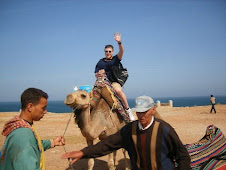
Son Isaac on Camel in Tangiers